Person · Politics & Government

Ted Cruz

@tedcruz
12 Events1970 – 202151 Years

1960
1970
1980
1990
2000
2010
2020
1966
1968
1972
1974
1976
1978
1982
1984
1986
1988
1992
1994
1996
1998
2002
2004
2006
2008
2012
2014
2016
2018
2022
2024
2026
18februari
2021
18 februari 2021

Cancún Controversy

On February 18, 2021, Ted Cruz faced significant backlash for traveling to Cancún, Mexico, during a severe winter storm that left millions of Texans without power and water. The trip, which Cruz initially described as a family vacation, was widely criticized as insensitive given the crisis in Texas. Cruz returned to Texas the following day and admitted that the trip was 'obviously a mistake.' The incident drew national attention and highlighted the scrutiny faced by public officials during times of crisis, impacting Cruz's public image.

Sources:
06januari
2021
06 januari 2021

Electoral College Vote Objection

On January 6, 2021, Ted Cruz was one of several Republican senators who objected to the certification of the Electoral College results from the 2020 Presidential Election. The objection was part of a broader effort to challenge the election outcome, which had declared Joe Biden the winner. The objection coincided with the Capitol riot, where a mob of Trump supporters stormed the Capitol building in an attempt to overturn the election results. Cruz's actions were met with widespread criticism and raised questions about his role in the events of that day.

Sources:
06november
2018
06 november 2018

Re-elected to U.S. Senate

On November 6, 2018, Ted Cruz was re-elected to the U.S. Senate, defeating Democratic challenger Beto O'Rourke in one of the most closely watched and expensive Senate races of the year. Cruz secured 50.9% of the vote compared to O'Rourke's 48.3%, in a race that drew national attention and record voter turnout. The campaign was marked by intense debates on issues such as healthcare, immigration, and gun rights. Cruz's victory reinforced his standing as a prominent conservative leader and highlighted the shifting political dynamics in Texas.

Sources:
20juli
2016
20 juli 2016

RNC Speech

On July 20, 2016, Ted Cruz delivered a controversial speech at the Republican National Convention in Cleveland, Ohio. During his address, Cruz notably refrained from endorsing the Republican nominee, Donald Trump, instead urging delegates and viewers to 'vote your conscience.' His decision not to endorse Trump drew boos from the convention floor and sparked significant media attention. The speech highlighted the deep divisions within the Republican Party and underscored Cruz's complex relationship with Trump, which would continue to evolve in the years following the election.

Sources:
03mei
2016
03 mei 2016

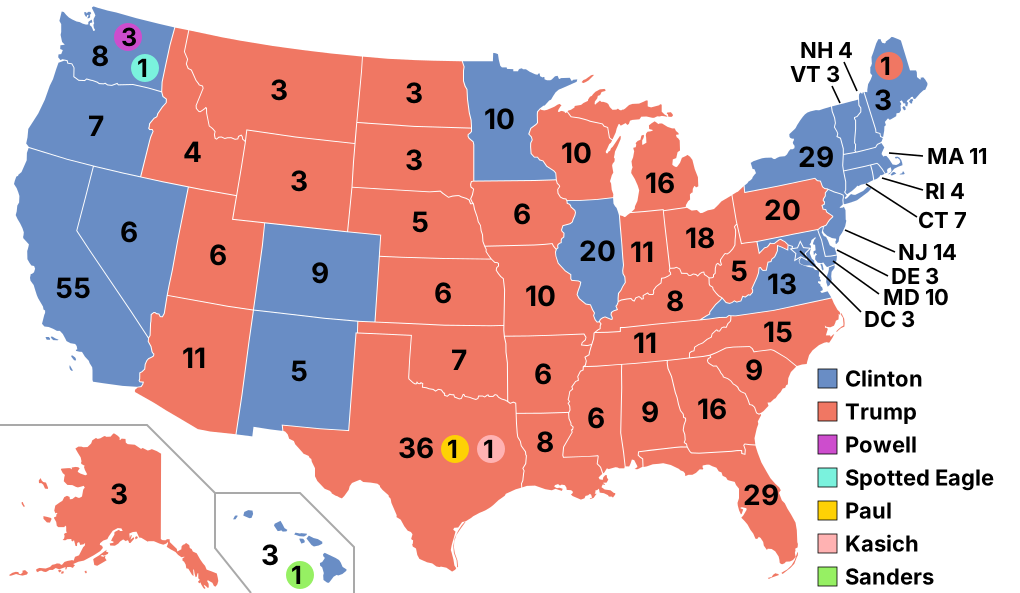
Suspends Presidential Campaign

On May 3, 2016, Ted Cruz suspended his presidential campaign following a decisive loss to Donald Trump in the Indiana primary. Cruz's withdrawal came after a hard-fought campaign in which he positioned himself as the main conservative alternative to Trump. Despite winning several states and garnering significant support from conservative and evangelical voters, Cruz was unable to overcome Trump's momentum. His decision to suspend the campaign effectively cleared the path for Trump to secure the Republican nomination, marking a pivotal moment in the 2016 election cycle.

Sources:
23maart
2015
23 maart 2015

Announcement of Presidential Candidacy

On March 23, 2015, Ted Cruz announced his candidacy for President of the United States at Liberty University in Lynchburg, Virginia. As the first major Republican candidate to enter the 2016 presidential race, Cruz's announcement set the stage for a highly competitive primary season. His campaign focused on conservative values, religious freedom, and a strict interpretation of the U.S. Constitution. Cruz's candidacy was notable for its appeal to evangelical voters and its emphasis on grassroots mobilization, which helped him secure several key victories in the early primaries.

Sources:
24september
2013
24 september 2013

21-Hour Senate Speech

On September 24, 2013, Ted Cruz delivered a marathon 21-hour speech on the Senate floor in an effort to block funding for the Affordable Care Act, commonly known as Obamacare. Although not technically a filibuster, the speech was one of the longest in Senate history and was intended to delay a vote on a continuing resolution to fund the government. Cruz's speech included references to popular culture and personal anecdotes, and it highlighted his commitment to conservative principles, solidifying his reputation as a leading voice in the Republican opposition to Obamacare.

Sources:
06november
2012
06 november 2012

Elected to the U.S. Senate

On November 6, 2012, Ted Cruz was elected as the U.S. Senator from Texas, defeating Democratic candidate Paul Sadler with 56.6% of the vote. Cruz's victory was significant as he became the first Hispanic American to represent Texas in the U.S. Senate. His campaign was marked by strong support from the Tea Party movement, and his election was seen as a triumph for conservative grassroots activism. Cruz's tenure in the Senate has been characterized by his staunch conservative positions and willingness to challenge the Republican establishment.

Sources:
01augustus
2008
01 augustus 2008

Joins Morgan, Lewis & Bockius LLP

In August 2008, Ted Cruz joined the law firm Morgan, Lewis & Bockius LLP as a partner in their Houston office. His practice focused on commercial litigation, international arbitration, and appellate work. Cruz's role at the firm allowed him to leverage his extensive legal experience and connections, further establishing his credentials in the legal community. His time in private practice was marked by high-profile cases and significant legal victories, which contributed to his rising prominence in the Republican Party.

Sources:
09januari
2003
09 januari 2003

Appointed Solicitor General of Texas

On January 9, 2003, Ted Cruz was appointed as the Solicitor General of Texas by then-Attorney General Greg Abbott. Cruz was the youngest Solicitor General in the United States and the first Hispanic to hold the position in Texas. During his tenure, he argued before the U.S. Supreme Court nine times, winning five cases. His work included significant cases such as Medellín v. Texas, which dealt with international law and the death penalty, showcasing his legal acumen and bolstering his reputation as a formidable litigator.

Sources:
01oktober
1995
01 oktober 1995

Graduates from Harvard Law School

In 1995, Ted Cruz graduated from Harvard Law School with a Juris Doctor degree. During his time at Harvard, he distinguished himself as a leading student by serving as a primary editor of the Harvard Law Review. He was also an executive editor of the Harvard Journal of Law and Public Policy and a founding editor of the Harvard Latino Law Review. His academic achievements at Harvard laid the foundation for his future legal and political career, where he became known for his strong advocacy skills.

Sources:
22december
1970
22 december 1970

Birth

Rafael Edward 'Ted' Cruz was born on December 22, 1970, in Calgary, Alberta, Canada. His father, Rafael Bienvenido Cruz, was a Cuban immigrant who fled to the United States after being imprisoned during the Cuban Revolution. His mother, Eleanor Elizabeth Wilson, was born in Delaware and is of Irish and Italian descent. Cruz's birth in Canada became a topic of discussion during his political career, particularly regarding his eligibility to run for the U.S. presidency.

Sources:

Frequently asked questions about Ted Cruz

Discover commonly asked questions regarding Ted Cruz. If there are any questions we may have overlooked, please let us know.

When did Ted Cruz run for President?

When did Ted Cruz suspend his presidential campaign?

When was Ted Cruz born?

When did Ted Cruz become a U.S. Senator?