Explore the rich history of the Vatican through our detailed timeline, highlighting key events and milestones. Discover its fascinating past!
The Second Vatican Council opened on 11 October 1962 and became one of the most consequential events ever associated with the Vatican. Convened by Pope John XXIII, it sought aggiornamento, or renewal, and led to major reforms in liturgy, ecumenism, relations with other religions, episcopal collegiality, and the church’s engagement with the modern world. Though a religious council rather than a state event, it permanently reshaped how the Vatican was perceived globally: less as an isolated court and more as the governing center of a church attempting dialogue with contemporary society. Its influence continues to define Catholic life worldwide.
The signing of the Lateran Treaty between the Holy See and the Kingdom of Italy on 11 February 1929 resolved the Roman Question and created Vatican City State as an independent sovereign entity. Italy recognized the pope’s temporal sovereignty over a compact territory surrounding Saint Peter’s, while the papacy recognized the Italian state with Rome as its capital. This agreement gave the modern Vatican its legal and political form, allowing the Holy See to operate with recognized independence in diplomacy, governance, and international relations. The treaty remains the decisive constitutional milestone in the history of Vatican City.
The capture of Rome by the Kingdom of Italy on 20 September 1870 ended the Papal States and transformed the political status of the papacy. Although the pope retained spiritual authority, he lost broad territorial rule and rejected the legitimacy of the new arrangement, beginning the long “Roman Question.” This crisis directly shaped the modern Vatican by forcing a redefinition of papal sovereignty from a regional state to a tiny but symbolically powerful enclave. The loss of temporal power also sharpened the distinction between the Holy See’s religious role and the future territorial entity that would emerge in the 20th century.
Pope Pius IX opened the First Vatican Council in Saint Peter’s Basilica on 8 December 1869 at a time of intense political and intellectual pressure on the church. The council addressed modern challenges to Catholic authority and would become most famous for defining papal primacy and papal infallibility under specific conditions. Its setting in the Vatican reinforced the site’s role not only as a ceremonial center but as a place where global Catholic doctrine was formally shaped. The council’s work strengthened the theological centrality of the papacy just as its territorial independence was about to face a severe political crisis.
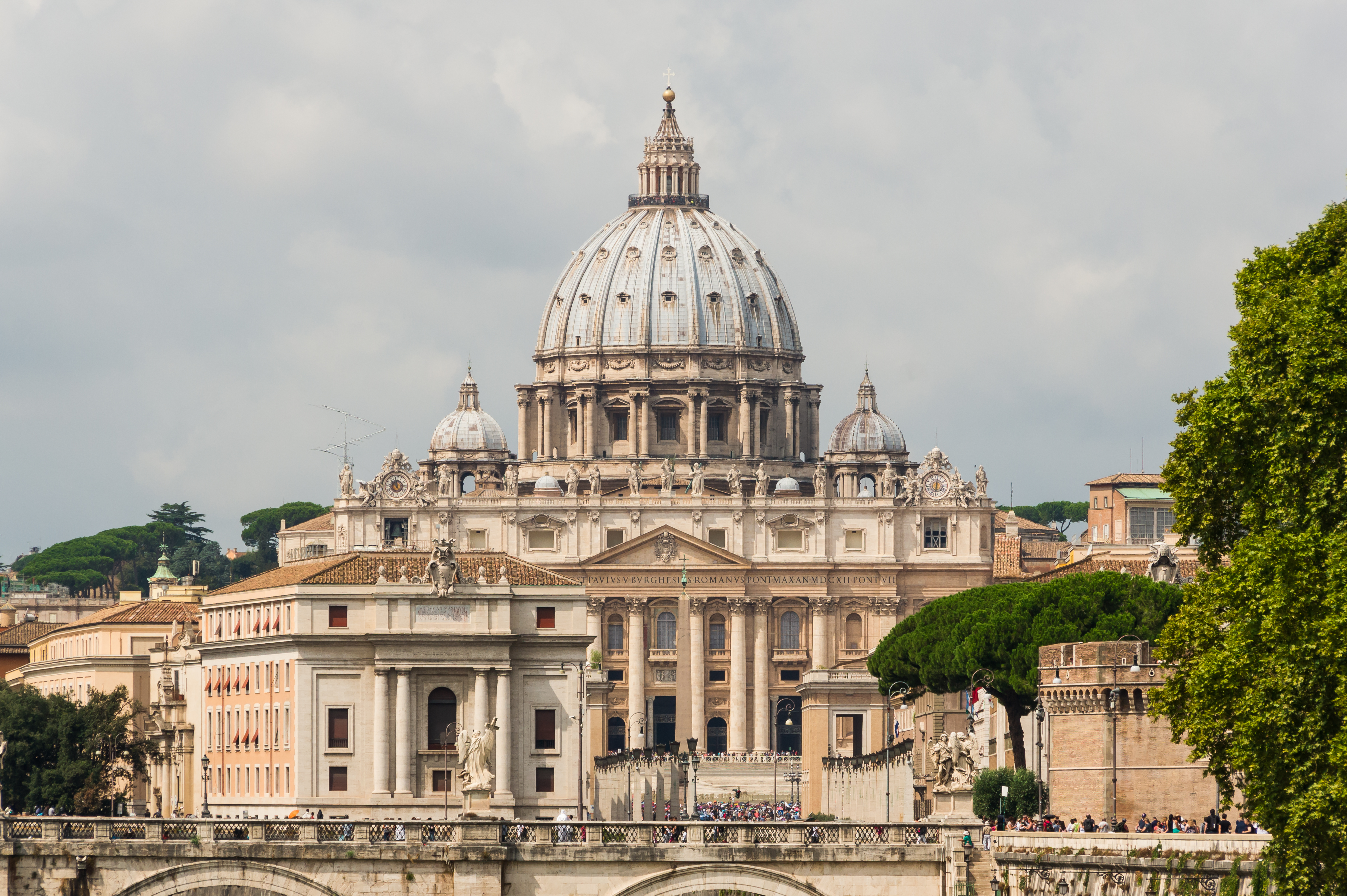
After more than a century of construction, the new Saint Peter’s Basilica was consecrated on 18 November 1626. Its completion gave the Vatican the monumental church that still defines its skyline and ceremonial life. The basilica brought together Renaissance planning and Baroque theatricality, housing relics, masterpieces, and papal liturgies on an unmatched scale. Its vast interior and commanding dome embodied the confidence of the post-Reformation papacy and made the Vatican a central destination for pilgrims, diplomats, artists, and rulers. The consecration marked the architectural completion of the Vatican’s most important sacred monument.
The Sack of Rome by mutinous imperial troops in 1527 was one of the most traumatic episodes in the history of the papacy and the city of Rome. The attack devastated churches, palaces, and neighborhoods, while Pope Clement VII took refuge in Castel Sant’Angelo after the desperate stand of the Swiss Guard. The event badly damaged papal prestige and is often seen as marking the end of the High Renaissance in Rome. For the Vatican, it underscored the vulnerability of papal power and accelerated later efforts at fortification, reform, and the reassertion of Catholic authority during the Counter-Reformation.
On 18 April 1506, Pope Julius II initiated construction of the new Saint Peter’s Basilica, replacing the ancient Constantinian church. The project became one of the defining architectural enterprises of the Renaissance and Baroque eras, involving major artists and architects including Bramante, Michelangelo, and Bernini. More than a building campaign, it represented the papacy’s effort to project universal authority, artistic magnificence, and continuity with the apostolic past. The basilica that emerged would become the visual and ceremonial centerpiece of the Vatican and one of the most recognizable religious structures in the world.
The discovery of the ancient sculpture group Laocoön and His Sons in Rome in 1506, and its rapid acquisition by Pope Julius II, is widely treated as the starting point of the Vatican Museums. The event symbolized the Renaissance papacy’s ambition to make the Vatican not only a spiritual center but also a major center of art, scholarship, and collecting. Over time, the papal collections expanded into one of the world’s most important museum complexes. This moment connected the Vatican to the revival of classical art and helped define its cultural influence far beyond religion alone.
The return of Pope Gregory XI from Avignon to Rome restored the city’s place as the operative seat of the papacy after nearly seven decades. This relocation was a decisive turning point in the history of the Vatican because it reestablished papal government and ceremonial life in Rome, despite the instability that soon followed. The move did not immediately end ecclesiastical division, but it reaffirmed the long-term linkage between the pope and the Roman seat of Saint Peter. From this point onward, the Vatican area increasingly resumed its role as the geographic center of Catholic authority.
When Pope Clement V established his court in Avignon in 1309, the center of papal administration shifted away from Rome for decades. This move did not erase Rome’s spiritual prestige, but it weakened the direct political and ceremonial role of the Vatican area. The absence of the popes affected local governance, architecture, and prestige, while critics saw the relocation as evidence of outside influence over the church. The Avignon Papacy became one of the great crises in papal history, and its eventual end would be central to restoring Rome and the Vatican as the enduring home of the papacy.
With the Donation of Pepin in the mid-8th century, the papacy acquired temporal sovereignty over extensive territory in central Italy, creating the Papal States. This development was crucial for the later Vatican because it made the pope not only a spiritual leader but also a territorial ruler. For more than a thousand years, papal independence was tied to control of land and government. The eventual loss of these territories in the 19th century would directly produce the “Roman Question” and ultimately lead to the creation of the much smaller but sovereign Vatican City State in 1929.
The dedication of the first great basilica at Saint Peter’s burial site established the Vatican Hill as one of the most important sacred landscapes in Christianity. Built under Emperor Constantine, Old St. Peter’s became the destination for pilgrims, liturgy, papal ceremony, and burial. Over centuries it drew rulers, clergy, and ordinary believers from across Europe and beyond. Its existence anchored the spiritual identity of the Vatican area long before Vatican City existed as a modern state, making the site inseparable from the authority, memory, and ceremonial life of the papacy.
A foundational moment in the early history of the papacy came when Emperor Constantine is traditionally associated with granting the Lateran Palace to Pope Miltiades. This gave the bishop of Rome a formal residence and administrative center within the imperial capital, helping transform the Roman church from a persecuted community into a publicly recognized institution. Although the Vatican Hill was not yet the main papal seat, this transfer marked the beginning of the papacy’s enduring territorial and ceremonial presence in Rome, setting the stage for later development of the Vatican as the symbolic heart of global Catholicism.
Discover commonly asked questions regarding Vatican. If there are any questions we may have overlooked, please let us know.
What are some key facts about the Vatican?
Why is the Vatican significant?
What is the legacy of the Vatican?
What is the Vatican City?