Organization · Other

Open Society Foundations

@opensocietyfoundations

Explore the key milestones and impactful events of Open Society Foundations. Discover their journey and influence on global social change.

Founded January 1, 1979
16Events
45Years
1978
1979
1980
1981
1982
1983
1984
1985
1986
1987
1988
1989
1990
1991
1992
1993
1994
1995
1996
1997
1998
1999
2000
2001
2002
2003
2004
2005
2006
2007
2008
2009
2010
2011
2012
2013
2014
2015
2016
2017
2018
2019
2020
2021
2022
2023
2024
Nov 1978
Dec
Feb
Mar
Apr
May
Jun
Jul
Aug
Sep
Oct
Nov
Dec
Feb
Mar
Apr
May
Jun
Jul
Aug
Sep
Oct
Nov
Dec
Feb
Mar
Apr
May
Jun
Jul
Aug
Sep
Oct
Nov
Dec
Feb
Mar
Apr
May
Jun
Jul
Aug
Sep
Oct
Nov
Dec
Feb
Mar
Apr
May
Jun
Jul
Aug
Sep
Oct
Nov
Dec
Feb
Mar
Apr
May
Jun
Jul
Aug
Sep
Oct
Nov
Dec
Feb
Mar
Apr
May
Jun
Jul
Aug
Sep
Oct
Nov
Dec
Feb
Mar
Apr
May
Jun
Jul
Aug
Sep
Oct
Nov
Dec
Feb
Mar
Apr
May
Jun
Jul
Aug
Sep
Oct
Nov
Dec
Feb
Mar
Apr
May
Jun
Jul
Aug
Sep
Oct
Nov
Dec
Feb
Mar
Apr
May
Jun
Jul
Aug
Sep
Oct
Nov
Dec
Feb
Mar
Apr
May
Jun
Jul
Aug
Sep
Oct
Nov
Dec
Feb
Mar
Apr
May
Jun
Jul
Aug
Sep
Oct
Nov
Dec
Feb
Mar
Apr
May
Jun
Jul
Aug
Sep
Oct
Nov
Dec
Feb
Mar
Apr
May
Jun
Jul
Aug
Sep
Oct
Nov
Dec
Feb
Mar
Apr
May
Jun
Jul
Aug
Sep
Oct
Nov
Dec
Feb
Mar
Apr
May
Jun
Jul
Aug
Sep
Oct
Nov
Dec
Feb
Mar
Apr
May
Jun
Jul
Aug
Sep
Oct
Nov
Dec
Feb
Mar
Apr
May
Jun
Jul
Aug
Sep
Oct
Nov
Dec
Feb
Mar
Apr
May
Jun
Jul
Aug
Sep
Oct
Nov
Dec
Feb
Mar
Apr
May
Jun
Jul
Aug
Sep
Oct
Nov
Dec
Feb
Mar
Apr
May
Jun
Jul
Aug
Sep
Oct
Nov
Dec
Feb
Mar
Apr
May
Jun
Jul
Aug
Sep
Oct
Nov
Dec
Feb
Mar
Apr
May
Jun
Jul
Aug
Sep
Oct
Nov
Dec
Feb
Mar
Apr
May
Jun
Jul
Aug
Sep
Oct
Nov
Dec
Feb
Mar
Apr
May
Jun
Jul
Aug
Sep
Oct
Nov
Dec
Feb
Mar
Apr
May
Jun
Jul
Aug
Sep
Oct
Nov
Dec
Feb
Mar
Apr
May
Jun
Jul
Aug
Sep
Oct
Nov
Dec
Feb
Mar
Apr
May
Jun
Jul
Aug
Sep
Oct
Nov
Dec
Feb
Mar
Apr
May
Jun
Jul
Aug
Sep
Oct
Nov
Dec
Feb
Mar
Apr
May
Jun
Jul
Aug
Sep
Oct
Nov
Dec
Feb
Mar
Apr
May
Jun
Jul
Aug
Sep
Oct
Nov
Dec
Feb
Mar
Apr
May
Jun
Jul
Aug
Sep
Oct
Nov
Dec
Feb
Mar
Apr
May
Jun
Jul
Aug
Sep
Oct
Nov
Dec
Feb
Mar
Apr
May
Jun
Jul
Aug
Sep
Oct
Nov
Dec
Feb
Mar
Apr
May
Jun
Jul
Aug
Sep
Oct
Nov
Dec
Feb
Mar
Apr
May
Jun
Jul
Aug
Sep
Oct
Nov
Dec
Feb
Mar
Apr
May
Jun
Jul
Aug
Sep
Oct
Nov
Dec
Feb
Mar
Apr
May
Jun
Jul
Aug
Sep
Oct
Nov
Dec
Feb
Mar
Apr
May
Jun
Jul
Aug
Sep
Oct
Nov
Dec
Feb
Mar
Apr
May
Jun
Jul
Aug
Sep
Oct
Nov
Dec
Feb
Mar
Apr
May
Jun
Jul
Aug
Sep
Oct
Nov
Dec
Feb
Mar
Apr
May
Jun
Jul
Aug
Sep
Oct
Nov
Dec
Feb
Mar
Apr
May
Jun
Jul
Aug
Sep
Oct
Nov
Dec
Feb
Mar
Apr
May
Jun
Jul
Aug
Sep
Oct
Nov
Dec
Feb
Mar
Apr
May
11maart
2024
11 maart 2024

Binaifer Nowrojee is appointed president of Open Society Foundations

On March 11, 2024, Open Society Foundations announced that Binaifer Nowrojee would become president, succeeding Mark Malloch-Brown in June. Her appointment was historically significant because she became the first woman from the global south to lead the organization. It also provided a public endpoint to a long period of transition, restructuring, and uncertainty inside the foundation. Coming after the board leadership transfer to Alexander Soros and major changes to staffing and grantmaking, the appointment suggested a new phase in which Open Society sought to stabilize its leadership while reaffirming its global mission around rights, equity, and justice.

01juli
2023
01 juli 2023

Open Society begins major restructuring and deep staff cuts

During 2023, Open Society Foundations began a sweeping restructuring under its new leadership, including plans to reduce staffing by as much as 40 percent and to shift to a new operating model. The changes followed earlier buyouts and internal transition steps that had begun in 2021, and they unsettled many grantees who depended on the foundation’s support. This milestone is important because it represented one of the biggest internal transformations in the organization’s history: a rethinking of how a very large philanthropy should operate after decades of growth, and after the generational transition from George Soros to his son.

11juni
2023
11 juni 2023

Alexander Soros takes over as board chair

In June 2023, Open Society Foundations confirmed that Alexander Soros had taken over as chair of the board after having assumed the role in December 2022. The leadership handover marked a generational transition at the top of the network founded and long dominated by George Soros. It mattered not only because of family succession, but because it coincided with a strategic overhaul of the organization’s structure, priorities, and staffing. As one of the world’s largest grantmaking philanthropies, any leadership shift at Open Society has implications far beyond the institution itself, affecting grantees, advocacy networks, and public debate across multiple regions.

23januari
2020
23 januari 2020

Open Society University Network is launched

In January 2020, Open Society launched the Open Society University Network, a global educational initiative linking universities and research institutions across different countries. The project aimed to expand access to higher education, encourage collaborative research, and support academic freedom, especially in places where independent learning institutions were under pressure. This was an important milestone because it renewed one of Open Society’s oldest commitments—education and critical inquiry—while updating it for a more interconnected and politically polarized world. It also showed the foundations moving from grant support alone toward building transnational institutional infrastructure for knowledge production.

20november
2018
20 november 2018

Open Society shuts its Turkey offices under government pressure

In November 2018, Open Society Foundations announced that it would cease operations in Turkey and close its offices in Istanbul and Ankara, citing what it called false accusations and a climate of intensifying pressure. The closure was a major milestone because it illustrated the limits facing transnational philanthropy in increasingly hostile political environments. Rather than a routine downsizing, it reflected a broader era in which governments in several countries portrayed independent civil society and foreign-funded rights organizations as threats. For Open Society, the Turkey exit underscored that defending open society principles often involved retreating from spaces where legal operation had become untenable.

15mei
2018
15 mei 2018

Open Society announces move of Budapest operations to Berlin

In May 2018, Open Society Foundations announced that it would move its Budapest-based international operations and staff to Berlin because of what it described as an increasingly repressive political and legal environment in Hungary. The relocation became one of the clearest symbols of the confrontation between the organization and authoritarian-leaning governments in Central Europe. It was an operational decision, but also a political marker: a network created in communist-era Hungary was now leaving the country where its institutional story began. Even after the move, Open Society said it would continue supporting Hungarian civil society from outside the country.

17oktober
2017
17 oktober 2017

George Soros transfers $18 billion to Open Society Foundations

On October 17, 2017, it was publicly reported that George Soros had transferred $18 billion of his personal wealth to Open Society Foundations. The move dramatically enlarged the organization’s financial base and placed it among the largest philanthropic foundations in the world. More than a funding event, the transfer signaled a long-term institutional commitment: Soros was converting a large share of his fortune into a permanent engine for grantmaking on democracy, human rights, justice, public health, and independent civil society. The scale of the gift also intensified political attention on the network in multiple countries.

01augustus
2010
01 augustus 2010

The organization adopts the name Open Society Foundations

In August 2010, the Open Society Institute began using the name Open Society Foundations. The rebranding mattered because it better described what the organization had become: not a single institute, but a global network of national and regional foundations, thematic programs, and affiliated initiatives. The new name emphasized both scale and plural structure while tying the network more explicitly to the political ideal of the open society. It marked the maturation of an organization that had grown far beyond its post-Cold War origins into one of the world’s largest philanthropic actors focused on rights, justice, and accountable governance.

01januari
1997
01 januari 1997

Roma rights work gains momentum with the Roma Participation Project

In 1997, Open Society’s work on behalf of Roma communities took on a more visible institutional form with the opening of the Roma Participation Project in Budapest. The initiative addressed segregation, stereotyping, and exclusion affecting Europe’s largest ethnic minority and helped make Roma rights a durable pillar of the foundations’ agenda. This milestone is important because it illustrates Open Society’s shift from broad democratic transition work toward sustained issue-based advocacy across the continent. It also foreshadowed later investments in Roma culture, arts, and political participation as integral parts of a more inclusive Europe.

01januari
1993
01 januari 1993

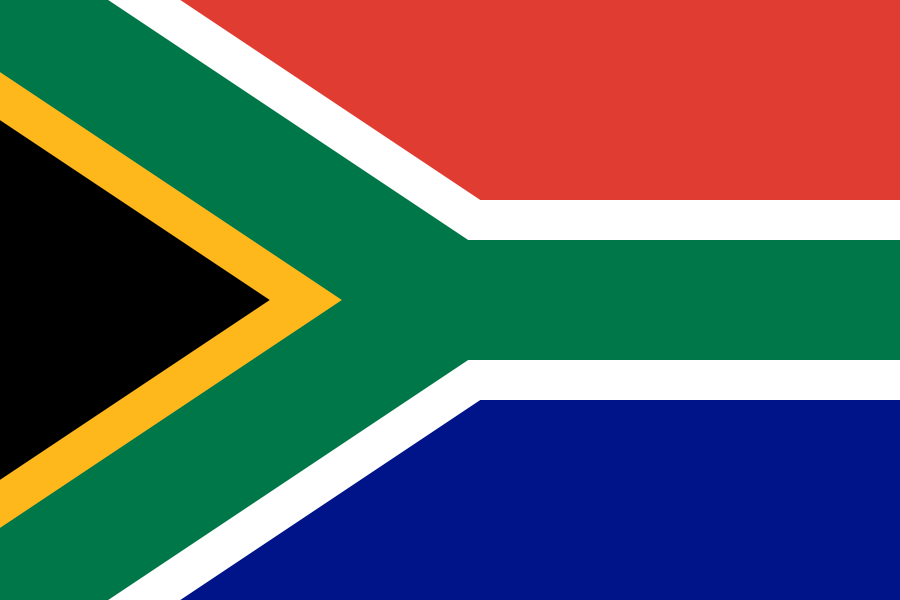
Open Society Foundation for South Africa opens in Cape Town

Also in 1993, the Open Society Foundation for South Africa opened its offices in Cape Town, linking Soros’s earlier anti-apartheid philanthropy to a permanent institutional presence in the country. The new foundation shifted from scholarship support under apartheid toward backing reconciliation, legal reform, education, public health, and independent media in a democratic South Africa. This was a significant milestone because it demonstrated how Open Society adapted after regime change: instead of ending its involvement once political transition occurred, it invested in the difficult work of making democratic institutions more inclusive and accountable over the long term.

01januari
1993
01 januari 1993

Open Society Institute is created in the United States

In 1993, the Open Society Institute was established in the United States to support and coordinate the expanding network of Soros foundations in Central and Eastern Europe and Russia. This was a major organizational milestone because it moved the project from a loose federation of country foundations into a more structured international institution with a recognizable administrative center. The institute also signaled a broader strategic shift: Open Society was no longer just reacting to political openings in former communist countries, but building a lasting philanthropic architecture capable of operating across regions and issues.

01januari
1991
01 januari 1991

Central European University opens, deepening Open Society’s educational mission

In 1991, Central European University opened with just over 100 students, championed and largely funded by George Soros. While legally distinct from Open Society Foundations, the university became one of the most visible institutional expressions of the same philosophy: that critical inquiry, academic freedom, and cross-border education are essential to democratic life. Its creation showed that Open Society’s ambitions extended beyond grantmaking into building durable educational institutions. The university helped train generations of students from post-communist and other societies undergoing political and social transformation.

09november
1989
09 november 1989

Network growth accelerates as communist rule collapses in Eastern Europe

By the time the Berlin Wall fell on November 9, 1989, Open Society had already established a foothold in countries including Poland, Ukraine, and Russia, and it soon expanded across much of Central and Eastern Europe and Central Asia. The collapse of communist rule transformed the foundations from a set of ventures supporting dissidents and independent thought into a broad grantmaking network engaged in democratic transition, legal reform, media freedom, education, and public accountability. This moment mattered because historical events caught up with the organization’s founding thesis, creating space for rapid institutional expansion.

01januari
1986
01 januari 1986

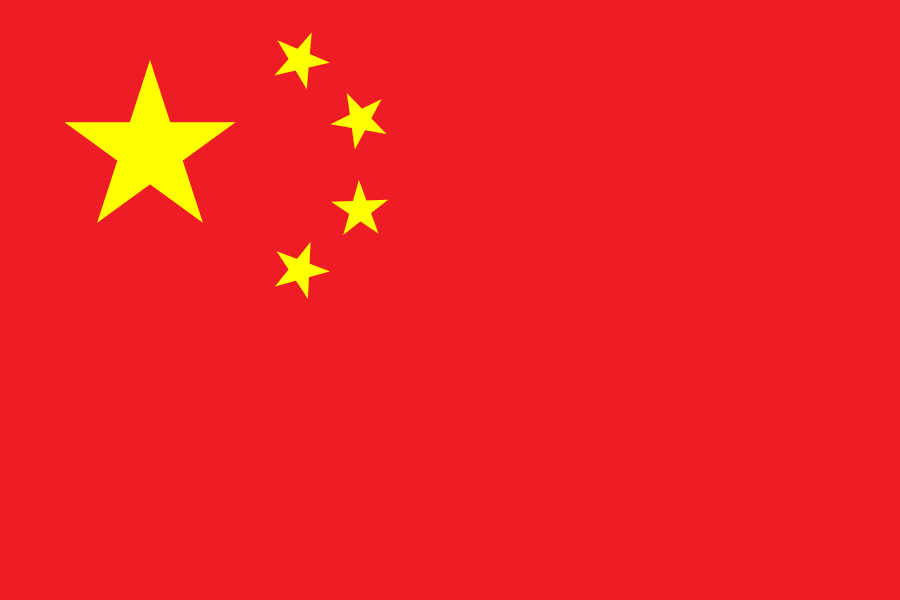
Open Society expands into China

In 1986, Soros opened another foundation in China, extending the emerging open-society model beyond Eastern Europe. The China effort reflected an ambition to support intellectual exchange and reform-oriented dialogue in another politically restricted environment. Although the initiative later became entangled in internal Communist Party struggles and closed in 1989 before the Tiananmen Square crackdown, the expansion was important because it showed that the network was not conceived as only an East European project. From an early stage, it was experimenting with a global mission centered on pluralism, information access, and reform.

28mei
1984
28 mei 1984

Soros Foundation Budapest is formally established

On May 28, 1984, George Soros signed the founding document for the Soros Foundation in Budapest with the Hungarian Academy of Sciences. This was a decisive milestone because it created the first major institutional base of what would become the Open Society Foundations network. Operating inside a Soviet-aligned state, the foundation backed freer access to knowledge and supported independent intellectual and civic activity. Its work, including distributing photocopiers and information resources to nonstate groups, symbolized a broader strategy: weakening monopolies over information as a pathway toward more open public life.

01januari
1979
01 januari 1979

George Soros begins the philanthropy that would grow into Open Society

The origins of Open Society Foundations trace to 1979, when George Soros began funding scholarships for Black South African students under apartheid and support for dissidents from communist Eastern Europe to study in the West. Those early grants established the model that would later define the network: using private philanthropy to widen access to education, information, and independent civic life in societies constrained by racial hierarchy or one-party rule. Although the formal institutional network did not yet exist, this year marks the practical beginning of the project that evolved into Open Society Foundations.

Frequently asked questions about Open Society Foundations

Discover commonly asked questions regarding Open Society Foundations. If there are any questions we may have overlooked, please let us know.

How does Open Society Foundations impact global issues?

What controversies surround Open Society Foundations?

What are the main goals of Open Society Foundations?

What is the Open Society Foundations?