Explore the groundbreaking timeline of penicillin's discovery, its impact on medicine, and key milestones in antibiotic development.
On December 10, 1945, Alexander Fleming, Howard Florey, and Ernst Boris Chain jointly received the Nobel Prize in Physiology or Medicine for the discovery of penicillin and its curative effect in infectious diseases. The award recognized not just Fleming's original observation in 1928 but also the later Oxford work that purified the drug, proved its therapeutic value, and enabled wider medical use. The Nobel ceremony cemented penicillin's place as one of the greatest medical advances of the twentieth century. It also helped shape public memory of the discovery, even though many additional contributors such as Norman Heatley and industrial researchers had been vital to the story.
In 1945, Dorothy Crowfoot Hodgkin and colleagues at Oxford used X-ray crystallography to confirm the molecular structure of penicillin, including its highly significant beta-lactam ring. This achievement resolved a major chemical puzzle and provided a firm basis for later antibiotic chemistry, including improved purification and the development of related drugs. During the war, the structure had strategic importance and publication was constrained, but the scientific result was a landmark in both chemistry and medicine. Understanding penicillin at the molecular level deepened knowledge of how it worked and helped lay foundations for the later expansion of beta-lactam antibiotics.
By the time of the Allied landings in Normandy on June 6, 1944, mass-produced penicillin was available in quantities sufficient to accompany frontline forces. Much of the supply came from American production, especially the new deep-tank fermentation facilities. Penicillin dramatically reduced deaths and complications from infected wounds, helping military surgeons manage trauma that would previously have led to sepsis, amputation, or death. Its use during D-Day symbolized the arrival of the antibiotic age on the battlefield and demonstrated how quickly a laboratory discovery from 1928 had become a strategic medical tool capable of altering wartime survival.
On March 1, 1944, Pfizer's Brooklyn penicillin plant formally opened with fourteen 7,500-gallon tanks and quickly became the leading supplier of the drug. Its success showed that deep-tank fermentation could produce penicillin at unprecedented scale and reliability, solving one of the greatest technical bottlenecks in the drug's history. The plant's output transformed penicillin from a precious, rationed medicine into a resource available for major military campaigns. This industrial achievement also helped establish the postwar model of antibiotic manufacturing, in which pharmaceutical companies used fermentation technology to produce life-saving drugs by the ton rather than the milligram.
In September 1943, Pfizer purchased the former Rubel Ice Plant on Marcy Avenue in Brooklyn and converted it into what became the world's first large-scale penicillin factory. This step was a milestone in pharmaceutical manufacturing because it committed major industrial resources to deep-tank fermentation at a moment when the process was still technically risky. The factory represented the marriage of microbiology, chemical engineering, and wartime necessity. By shifting from improvised lab vessels to industrial fermenters, manufacturers could at last begin producing penicillin in volumes suitable for military medicine and, soon afterward, civilian use on a broad scale.
On April 5, 1943, the British War Cabinet set up the Penicillin Committee to coordinate policy, distribution, and production planning for the antibiotic during the Second World War. The decision reflected the fact that penicillin had moved beyond the laboratory and become a strategic medical resource with military implications. Officials now had to decide who would receive limited supplies, how to collaborate with American manufacturers, and how to integrate penicillin into wartime medicine. The committee's creation marked the moment when penicillin became a national priority rather than solely a scientific or hospital-based undertaking.
On March 14, 1942, Anne Miller, a patient at New Haven Hospital with a severe streptococcal infection, became the first person in the United States whose life was saved by penicillin. The precious drug had to be rushed to the hospital, and her recovery offered dramatic public proof that penicillin was not only scientifically remarkable but clinically transformative. This case helped persuade American physicians, officials, and manufacturers that rapid expansion of production was worth the cost and urgency. It also marked the transition of penicillin from an experimental British wartime project into a therapy of broad transatlantic importance.
In the summer of 1941, Howard Florey and Norman Heatley traveled to the United States because wartime Britain lacked the industrial capacity to manufacture penicillin in the quantities needed for broad clinical use. With support from the Rockefeller Foundation and contacts arranged through Yale, they reached the U.S. Department of Agriculture's Northern Regional Research Laboratory in Peoria, Illinois. This journey was a major milestone because it internationalized the project and linked academic discovery to American fermentation expertise. The move set in motion the industrial breakthroughs that would make penicillin widely available during the war rather than remaining a scarce experimental drug.
On February 12, 1941, Albert Alexander, a policeman suffering from a severe systemic infection, became the first person to receive penicillin produced by the Oxford team. Treated at the Radcliffe Infirmary, he showed a dramatic early improvement, demonstrating that the drug could work in humans as spectacularly as it had in the mouse experiments. However, the team had so little penicillin available that they even recovered the drug from his urine for reuse, and supplies still ran out before the infection was fully defeated. Alexander's death soon afterward was tragic, but the case proved penicillin's extraordinary promise and accelerated efforts to increase production.
During 1941, researchers at the Northern Regional Research Laboratory in Peoria, especially Andrew Moyer and colleagues working with Heatley, discovered ways to raise penicillin yields sharply by changing the growth medium. Using lactose in place of sucrose and adding corn steep liquor, a by-product of corn processing, they improved the mold's productivity and made industrial scale-up far more realistic. These innovations were not as publicly famous as Fleming's original observation, but they were essential to turning penicillin into a manufacturable medicine. Without these production gains, clinical demand during World War II could not have been met in time to save large numbers of lives.
By May 1940, the Oxford group had purified enough penicillin to perform decisive animal experiments. In tests led by Florey and supported by Norman Heatley's production methods, infected mice that received penicillin survived while untreated mice died. These results provided the first strong evidence that penicillin could act as a powerful systemic antibacterial drug in a living body rather than only on a culture plate. The success of the mouse trials gave the Oxford team confidence to scale up production under wartime conditions and move toward human trials, even though available quantities remained tiny and the extraction process was painstakingly inefficient.
In 1939, Howard Florey, Ernst Boris Chain, and colleagues at the Sir William Dunn School of Pathology at the University of Oxford began a concerted effort to investigate naturally occurring antibacterial substances, with penicillin becoming a central focus. Chain drew attention to Fleming's overlooked paper, and the group set out to purify the compound, study its chemistry, and test whether it could work inside living organisms. This was the crucial turning point that transformed penicillin from an interesting observation into a serious therapeutic research program. The Oxford team's work provided the organization, technical skill, and persistence that Fleming alone had not been able to supply a decade earlier.
In June 1929, Fleming published his findings on penicillin in the British Journal of Experimental Pathology. The paper documented the antibacterial effect of the mold filtrate and preserved the discovery in the scientific record, even though he was unable to purify the unstable substance or turn it into a dependable treatment. At the time, the medical world showed little enthusiasm, and penicillin was viewed more as a laboratory curiosity than a practical drug. Still, the publication became the essential reference that later allowed researchers at Oxford to revive and extend Fleming's neglected work.
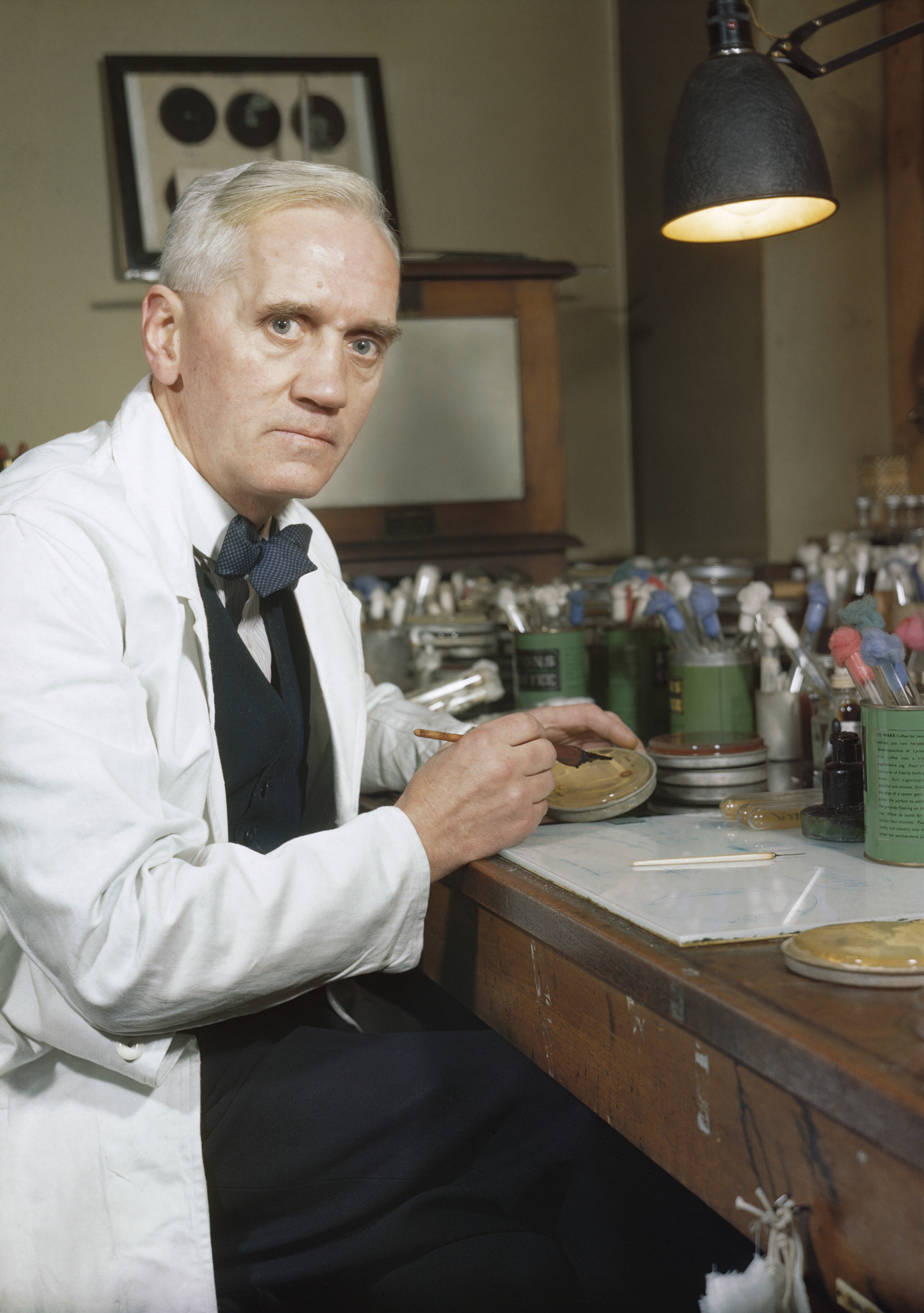
On September 28, 1928, Alexander Fleming returned to his laboratory at St Mary's Hospital Medical School in London and noticed that a contaminated culture plate of staphylococci had developed an unusual clear zone around a stray mold colony. The bacteria nearest the mold had been destroyed, suggesting that the mold was releasing a powerful antibacterial substance. Fleming identified the mold as belonging to the Penicillium group and named the active substance "penicillin." This chance observation did not immediately transform medicine, but it marked the true beginning of the scientific history of penicillin and of the antibiotic era that followed.
Discover commonly asked questions regarding Discovery of penicillin. If there are any questions we may have overlooked, please let us know.
Who discovered penicillin and when?
What is the legacy of penicillin?
What is the significance of penicillin in medicine?
What are some key facts about penicillin?
Timepaths that crossed paths with Discovery of penicillin