World Event · Other

2014 in Ukraine

@2014inukraine

Explore the pivotal events of 2014 in Ukraine, from the Euromaidan protests to the annexation of Crimea. Discover the timeline now!

16Events
2014
2014
2014
2014
2014
2014
2014
2014
2014
2014
2014
2014
2014
2014
2014
2014
2014
2014
2014
2014
2014
2014
2014
2014
2014
2014
2014
2014
2014
2014
2014
2014
2014
2014
2014
13 Jan
14 Jan
15 Jan
16 Jan
17 Jan
18 Jan
20 Jan
21 Jan
22 Jan
23 Jan
24 Jan
25 Jan
27 Jan
28 Jan
29 Jan
30 Jan
31 Jan
1 Feb
3 Feb
4 Feb
5 Feb
6 Feb
7 Feb
8 Feb
10 Feb
11 Feb
12 Feb
13 Feb
14 Feb
15 Feb
17 Feb
18 Feb
19 Feb
20 Feb
21 Feb
22 Feb
24 Feb
25 Feb
26 Feb
27 Feb
28 Feb
1 Mar
3 Mar
4 Mar
5 Mar
6 Mar
7 Mar
8 Mar
10 Mar
11 Mar
12 Mar
13 Mar
14 Mar
15 Mar
17 Mar
18 Mar
19 Mar
20 Mar
21 Mar
22 Mar
24 Mar
25 Mar
26 Mar
27 Mar
28 Mar
29 Mar
31 Mar
1 Apr
2 Apr
3 Apr
4 Apr
5 Apr
7 Apr
8 Apr
9 Apr
10 Apr
11 Apr
12 Apr
14 Apr
15 Apr
16 Apr
17 Apr
18 Apr
19 Apr
21 Apr
22 Apr
23 Apr
24 Apr
25 Apr
26 Apr
28 Apr
29 Apr
30 Apr
1 May
2 May
3 May
5 May
6 May
7 May
8 May
9 May
10 May
12 May
13 May
14 May
15 May
16 May
17 May
19 May
20 May
21 May
22 May
23 May
24 May
26 May
27 May
28 May
29 May
30 May
31 May
2 Jun
3 Jun
4 Jun
5 Jun
6 Jun
7 Jun
9 Jun
10 Jun
11 Jun
12 Jun
13 Jun
14 Jun
16 Jun
17 Jun
18 Jun
19 Jun
20 Jun
21 Jun
23 Jun
24 Jun
25 Jun
26 Jun
27 Jun
28 Jun
30 Jun
1 Jul
2 Jul
3 Jul
4 Jul
5 Jul
7 Jul
8 Jul
9 Jul
10 Jul
11 Jul
12 Jul
14 Jul
15 Jul
16 Jul
17 Jul
18 Jul
19 Jul
21 Jul
22 Jul
23 Jul
24 Jul
25 Jul
26 Jul
28 Jul
29 Jul
30 Jul
31 Jul
1 Aug
2 Aug
4 Aug
5 Aug
6 Aug
7 Aug
8 Aug
9 Aug
11 Aug
12 Aug
13 Aug
14 Aug
15 Aug
16 Aug
18 Aug
19 Aug
20 Aug
21 Aug
22 Aug
23 Aug
25 Aug
26 Aug
27 Aug
28 Aug
29 Aug
30 Aug
1 Sep
2 Sep
3 Sep
4 Sep
5 Sep
6 Sep
8 Sep
05september
2014
05 september 2014

Minsk Protocol establishes a first major ceasefire framework

On 5 September 2014, representatives of Ukraine, Russia, the OSCE, and separatist entities signed the Minsk Protocol in Belarus, creating the first major ceasefire framework for the Donbas war. Although the truce was repeatedly violated and failed to produce a durable peace, it was a significant milestone because it established the diplomatic architecture that would shape negotiations for years. The agreement reflected the reality that the conflict could not be solved quickly on the battlefield alone and that international mediation had become central. Minsk therefore marked the transition from rapid escalation in 2014 to a prolonged, unsettled conflict with recurring talks and periodic fighting.

24augustus
2014
24 augustus 2014

Independence Day military parade underscores wartime national mobilization

On 24 August 2014, Ukraine marked Independence Day in Kyiv with a military parade held under the shadow of active war in the east. The event had unusual symbolic weight because it aimed to project state continuity, public resilience, and national unity at a time when Ukrainian territory had been seized in Crimea and fighting was intensifying in the Donbas. In the context of 2014, the parade reflected the rapid remobilization of Ukrainian state identity and armed forces after the upheavals of the spring. It also illustrated how national commemorations were being transformed into demonstrations of wartime endurance and political defiance.

17juli
2014
17 juli 2014

Malaysia Airlines Flight MH17 is shot down over eastern Ukraine

On 17 July 2014, Malaysia Airlines Flight MH17 was destroyed over eastern Ukraine, killing all 298 people aboard. The aircraft was brought down in territory controlled by separatist forces during the Donbas conflict, turning a regional war into a global outrage. The disaster transformed international perceptions of the conflict because it showed that the violence in eastern Ukraine had consequences far beyond the battlefield. The crash intensified sanctions pressure on Russia, increased scrutiny of the separatists and their backers, and became one of the most internationally consequential events of the entire year in Ukraine.

05juli
2014
05 juli 2014

Ukrainian forces retake Sloviansk

On 5 July 2014, Ukrainian forces regained control of Sloviansk after separatist fighters withdrew from the city. Because Sloviansk had been one of the first and most symbolic militant strongholds in the Donbas, its recapture was treated in Kyiv as a major military and political success. It demonstrated that Ukrainian forces, which had been disorganized in the spring, were becoming more capable of offensive operations. At the same time, the broader conflict did not end; instead, fighting shifted and intensified around other urban centers, showing that the war had entered a more entrenched and destructive phase rather than moving toward quick resolution.

25mei
2014
25 mei 2014

Petro Poroshenko wins Ukraine’s presidential election

On 25 May 2014, Ukraine held an early presidential election that brought Petro Poroshenko to power in a first-round victory. Conducted after the collapse of Yanukovych’s presidency and amid fighting in the east, the election was a crucial attempt to restore constitutional legitimacy and establish a recognized head of state. Voting could not be conducted normally in Crimea and parts of the Donbas, underscoring the country’s fractured condition. Nevertheless, the result gave Ukraine a new leadership center at a moment of acute crisis and shaped the state’s diplomatic and military response during the remainder of 2014.

11mei
2014
11 mei 2014

Separatists stage self-rule referendums in Donetsk and Luhansk

On 11 May 2014, separatist authorities in Donetsk and Luhansk held hastily organized votes on “self-rule” or sovereignty. Ukraine, Western governments, and many international observers rejected the referendums as illegitimate, noting the wartime conditions, lack of standard electoral safeguards, and absence of recognition by lawful Ukrainian institutions. Even so, the votes were politically significant because separatist leaders used them to claim popular legitimacy and push the conflict further away from a short-term political settlement. They helped entrench parallel authorities in the Donbas and deepened the split between Kyiv and the regions under separatist control.

02mei
2014
02 mei 2014

Deadly violence and fire at Odesa Trade Unions House

On 2 May 2014, clashes between pro-Ukrainian and pro-Russian groups in Odesa culminated in a fire at the Trade Unions House that killed dozens of people. The tragedy became one of the most emotionally charged and contested episodes of 2014, with rival narratives emerging immediately about responsibility and intent. Beyond its local significance, the Odesa deaths deepened polarization across Ukraine and in international perceptions of the crisis. They were used extensively in propaganda and grievance politics, hardening attitudes at a moment when the country was already fragmenting under violence, separatism, and external intervention.

12april
2014
12 april 2014

Armed militants seize Sloviansk, expanding the Donbas war

On 12 April 2014, armed men seized police and security buildings in Sloviansk, a strategically important city in Donetsk region. The takeover, linked to organized militant leadership rather than spontaneous protest alone, signaled a new phase in eastern Ukraine: the conflict was becoming an armed insurgency. Kyiv responded by launching what it termed an “anti-terrorist operation,” beginning sustained fighting in the Donbas. Sloviansk soon emerged as one of the war’s first major strongholds and battlefields, making this seizure one of the clearest starting points of open warfare between Ukrainian forces and Russian-backed separatists in 2014.

07april
2014
07 april 2014

Separatists proclaim the Donetsk People’s Republic

On 7 April 2014, pro-Russian separatists occupying the regional administration building in Donetsk proclaimed the creation of the Donetsk People’s Republic. The declaration followed weeks of unrest in eastern Ukraine after the fall of Yanukovych and Russia’s annexation of Crimea. Although initially framed by its supporters as a local uprising, the movement quickly became intertwined with Russian backing, armed organization, and cross-border influence. The proclamation was a milestone because it transformed unrest into a more formal separatist project, laying the institutional and symbolic foundations for the war in the Donbas.

18maart
2014
18 maart 2014

Russia formalizes annexation of Crimea

On 18 March 2014, Russia formally moved to absorb Crimea after the disputed referendum, completing the political phase of the peninsula’s seizure from Ukraine. The annexation was condemned by Ukraine and by most states as a violation of sovereignty and international law. For Ukraine, the loss of Crimea was both a strategic and symbolic shock: it stripped Kyiv of control over a key Black Sea territory and intensified fears that Russian intervention might spread elsewhere. The annexation also triggered sanctions and set the framework for years of diplomatic confrontation, military tension, and non-recognition by much of the world.

16maart
2014
16 maart 2014

Crimea holds disputed referendum on joining Russia

On 16 March 2014, authorities in Crimea held a hastily organized referendum under Russian military occupation on whether the region should leave Ukraine and join Russia. Ukraine and most of the international community rejected the vote as illegal and illegitimate, citing both the presence of foreign troops and violations of Ukrainian constitutional procedure. Nevertheless, the referendum gave Moscow a political pretext to formalize annexation within days. The event was a watershed in post-Cold War Europe because it redrew borders by force and became a central grievance in Ukraine’s relations with Russia and the wider international order.

27februari
2014
27 februari 2014

Armed men seize Crimea’s parliament in Simferopol

Before dawn on 27 February 2014, heavily armed men without insignia took control of the Crimean parliament and government buildings in Simferopol, raising Russian flags over the complex. Their seizure of key institutions enabled the rapid installation of a pro-Russian regional leadership and opened the way for the formal takeover of the peninsula. The operation became one of the clearest early signs of Russia’s covert military intervention in Ukraine in 2014. It transformed a political crisis into a territorial one and marked the beginning of the loss of Ukrainian control over Crimea.

22februari
2014
22 februari 2014

Yanukovych flees Kyiv and parliament removes him from power

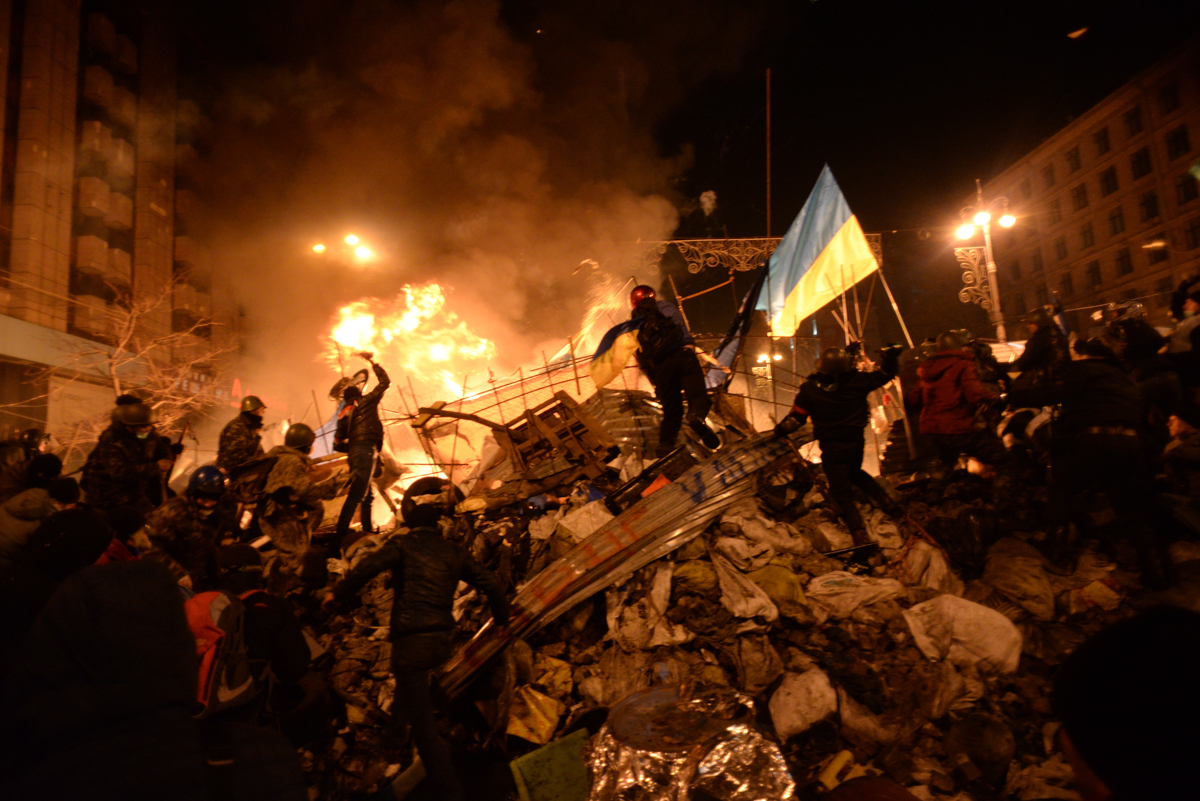
On 22 February 2014, Viktor Yanukovych left Kyiv as protesters and lawmakers moved to take control of the state after the collapse of his government. Parliament declared that he had withdrawn from fulfilling his constitutional duties and scheduled an early presidential election. The day also saw the release of former prime minister Yulia Tymoshenko and the symbolic opening of Yanukovych’s lavish Mezhyhirya residence to the public. This moment marked the effective victory of the Revolution of Dignity and the beginning of a profound reordering of Ukrainian politics, but it also triggered Russian moves in Crimea and contributed directly to the wider conflict that followed.

21februari
2014
21 februari 2014

Yanukovych and opposition sign crisis settlement agreement

On 21 February 2014, President Viktor Yanukovych and opposition leaders signed an agreement intended to defuse the crisis after days of mass killings in Kyiv. The deal called for a return to the 2004 constitution, formation of a national unity government, and early presidential elections. Although backed by European mediators, it failed almost immediately because events on the ground had moved faster than diplomacy. Protesters distrusted the compromise, state authority was collapsing, and Yanukovych’s position had become untenable. The agreement remains important as the last formal attempt to preserve a negotiated transition before the government fell apart.

18februari
2014
18 februari 2014

Deadly clashes erupt in Kyiv during the Revolution of Dignity

On 18 February 2014, clashes between protesters and security forces in central Kyiv entered their deadliest phase. Fighting around government buildings and Maidan Nezalezhnosti escalated into mass bloodshed over the following days, with scores killed and many more wounded. The violence shattered hopes for a negotiated settlement under existing conditions and deeply delegitimized Yanukovych’s rule in the eyes of many Ukrainians. These killings became one of the defining traumas of modern Ukrainian history, crystallizing the Revolution of Dignity and setting in motion the collapse of the incumbent government only days later.

16januari
2014
16 januari 2014

Parliament passes anti-protest laws amid Euromaidan crisis

On 16 January 2014, Ukraine’s parliament approved a package of restrictive laws that sharply curtailed protest rights, expanded penalties for demonstrations, and criminalized several forms of civic activism. Passed during the escalating Euromaidan movement, the measures were widely viewed by opponents as a major authoritarian turn under President Viktor Yanukovych. The laws intensified public anger rather than restoring order, helping transform a protest movement focused on European integration into a broader struggle over state violence, constitutional order, and Ukraine’s political future. Their adoption marked an important turning point in the 2014 crisis by accelerating confrontation between the government and protesters in Kyiv and beyond.

Frequently asked questions about 2014 in Ukraine

Discover commonly asked questions regarding 2014 in Ukraine. If there are any questions we may have overlooked, please let us know.

Why is 2014 considered a pivotal year for Ukraine?

What has been the legacy of the 2014 events in Ukraine?

What was the international response to the events in Ukraine in 2014?

What were the main events in Ukraine during 2014?

Related Timepaths

Timepaths that crossed paths with 2014 in Ukraine